
AMD K6 2/500AFX 500 MHz CPU
$ 7.92
Description
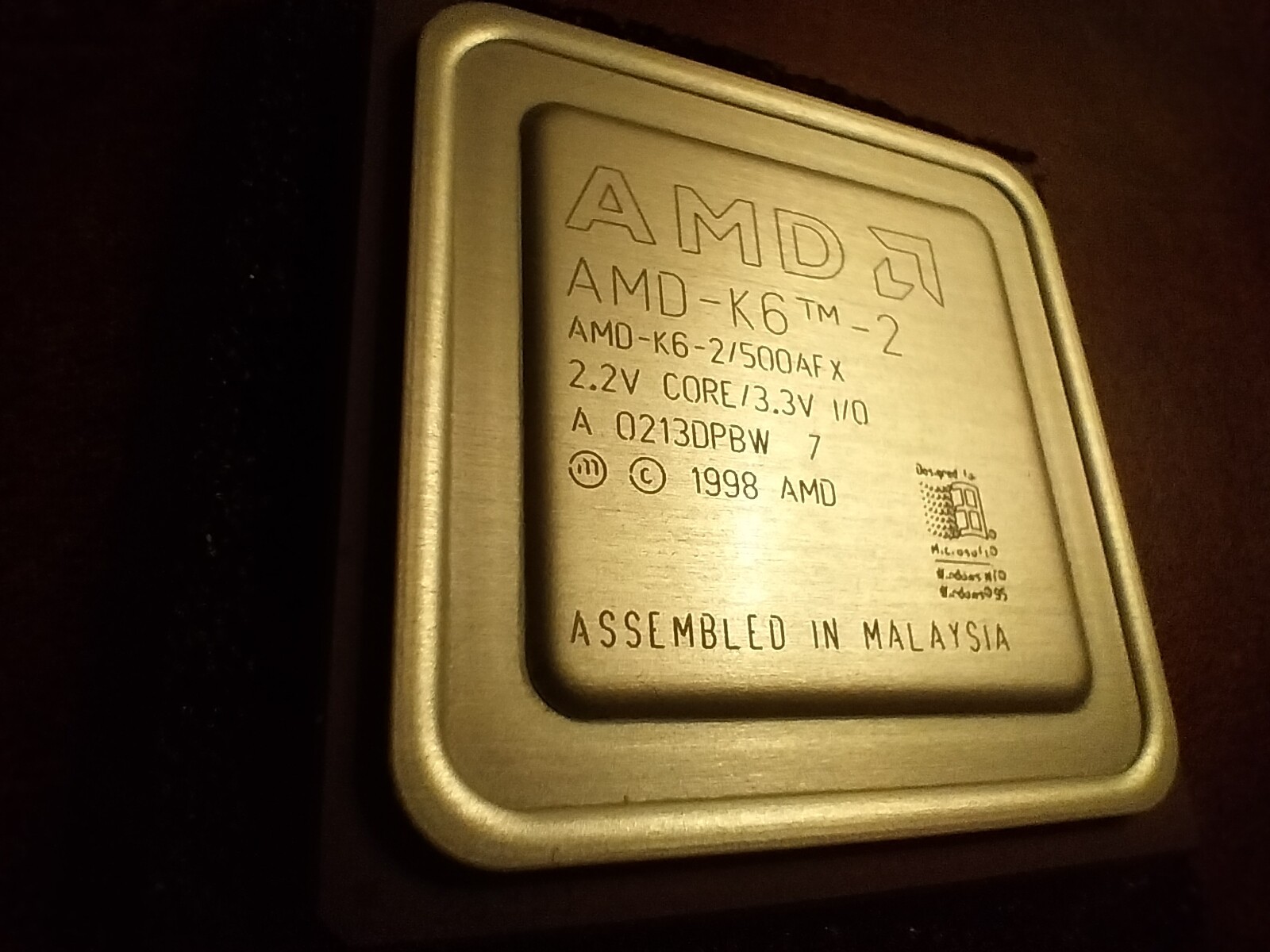
AMD K6 2/500AFX 500 MHz CPU. Multiplier: 5x (locked; 100 MHz × 5 = 500 MHz). It's highly sought after in retro builds for maxing out Super Socket 7 systems (often paired with 100–133 MHz FSB boards, Voodoo graphics, and 128–256 MB SDRAM).". The following is AI generated: "The AMD-K6-2/500AFX (often just called the AMD K6-2 500 MHz) is a late-1999 vintage x86 processor from AMD's K6-2 family, part of the "Chomper" (or Chomper CXT) core revision. It was one of the top clock speeds in the non-Plus K6-2 lineup and was aimed at budget-friendly performance for Windows 98-era gaming and productivity, competing with Intel's Pentium II/III while adding 3DNow! instructions for better 3D acceleration in compatible games/apps. Here are the key technical specifications: Clock Speed: 500 MHz (exactly 500 MHz nominal; some sources list 499.99 MHz due to precise FSB math) Bus Speed (FSB): 100 MHz Multiplier: 5x (locked; 100 MHz × 5 = 500 MHz) Core: Chomper (CXT variant) Manufacturing Process: 0.25 micron (250 nm) Transistors: 9.3 million Die Size / Architecture: Single-core, 32-bit x86 compatible L1 Cache: 32 KB instruction (code) + 32 KB data (writeback), 2-way set associative Extensions/Instructions: MMX, 3DNow! (enhanced floating-point for 3D graphics) Core Voltage (Vcore): 2.2V nominal (±0.1V tolerance; some datasheets allow 2.1V–2.3V) I/O Voltage: 3.3V nominal (3.135V–3.6V range) TDP / Power Consumption: Around 21–25W (typical for the era; varies slightly with load) Operating Temperature: 0°C to 65°C case (some variants up to higher with cooling) Package: 321-pin Ceramic Pin Grid Array (CPGA), staggered PGA, with integrated heat spreader (roughly 1.95" × 1.95") Socket: Super Socket 7 (enhanced Socket 7; backward compatible with many Socket 7 boards, but needs 100 MHz FSB support for full speed) CPUID: Family 5, Model 8 (08h), Stepping 12 (0Ch) or similar late stepping; often shows as 58C in tools Introduction Date: Around August 1999 (launched late 1999) Original MSRP: Approximately $167 (at launch for OEM/tray versions) This CPU performs roughly on par with a Pentium II 300–350 MHz in many tasks, sometimes faster in 3DNow!-optimized games/apps (e.g., better in some Glide/Direct3D titles), but it can lag in others like certain Quake engines due to weaker FPU compared to Intel. It's highly sought after in retro builds for maxing out Super Socket 7 systems (often paired with 100–133 MHz FSB boards, Voodoo graphics, and 128–256 MB SDRAM)."